Designing Metamaterials

From Digital Models to Additive Manufacturing

August 24 – 28, 2026
an International Summer School
organized by the
D³ Research Training Group 2868 and the Dresden Center for Computational Materials Science (DCMS).


Data science and machine learning have deeply affected the field of material science. The upcoming of data-driven methods redefined both objectives and tasks and lead to the development of utterly new methods. This summer school offer comprehensive, multidisciplinary insights into these new developments, extending from machine learning to experimental characterization, including alloy design and mechanistic modeling. Internationally renowned speakers will share their perspectives in a 5-day workshop in the spectrum of data-driven design of materials and structures. The lectures will be extended by hands-on sessions to achieve a greater understanding of the latest scientifical developments.
To foster interaction between participants, experts and D³ fellows, the school is complemented by a social program.
The Summer School is organized by fellows of the Research Training Group 2868 D³ - Data-Driven Design of resilient metamaterials together with the Dresden Center for Materials Science (DCMS). It is scheduled for August 24 – 28, 2026. Venue is TUD University of Technology Dresden

  • Structural Optimization
  • Architected Materials
  • Inverse Material Design
  • Material Manufacturing

  • Alloy Design
  • Multiscale Modeling
  • Phase Diagrams
  • Machine Learning
  • Experimental Characterization
  • Computational Mechanics
  • Computational Material Science
  • Model Discovery and Parametrization
Credits: Jiuguang Wang ( CC BY-SA 2.0 )

Confirmed Lecturers

Professor Kästner is focusing on the development of data-driven analysis and techniques for material multi-scale modeling along with the experimental characterization of additively manufactured materials. His research interests encompass a large scope of subjects, from inverse material design to damage and fracture analysis. He is a full professor at the TU Dresden where he received his PhD in 2015. Among his projects belongs the research training group D³ on data-driven design of metamaterials aiming to develop novel resilient materials.

The research training group D³ - Data-Driven design of metamaterials - is aiming to the exploration of novel cross-scale materials and structures achieving enhanced mechanical performances. This challenge is tackled by an interdisciplinary team involving experts in computational mechanics, data and computer science, materials science, mechanical engineering, mathematics, and physics. To achieve its objectives, the D³ adresses various challenges, from the structure optimization to the functionalization, including the alloy design and the mechanical testing.

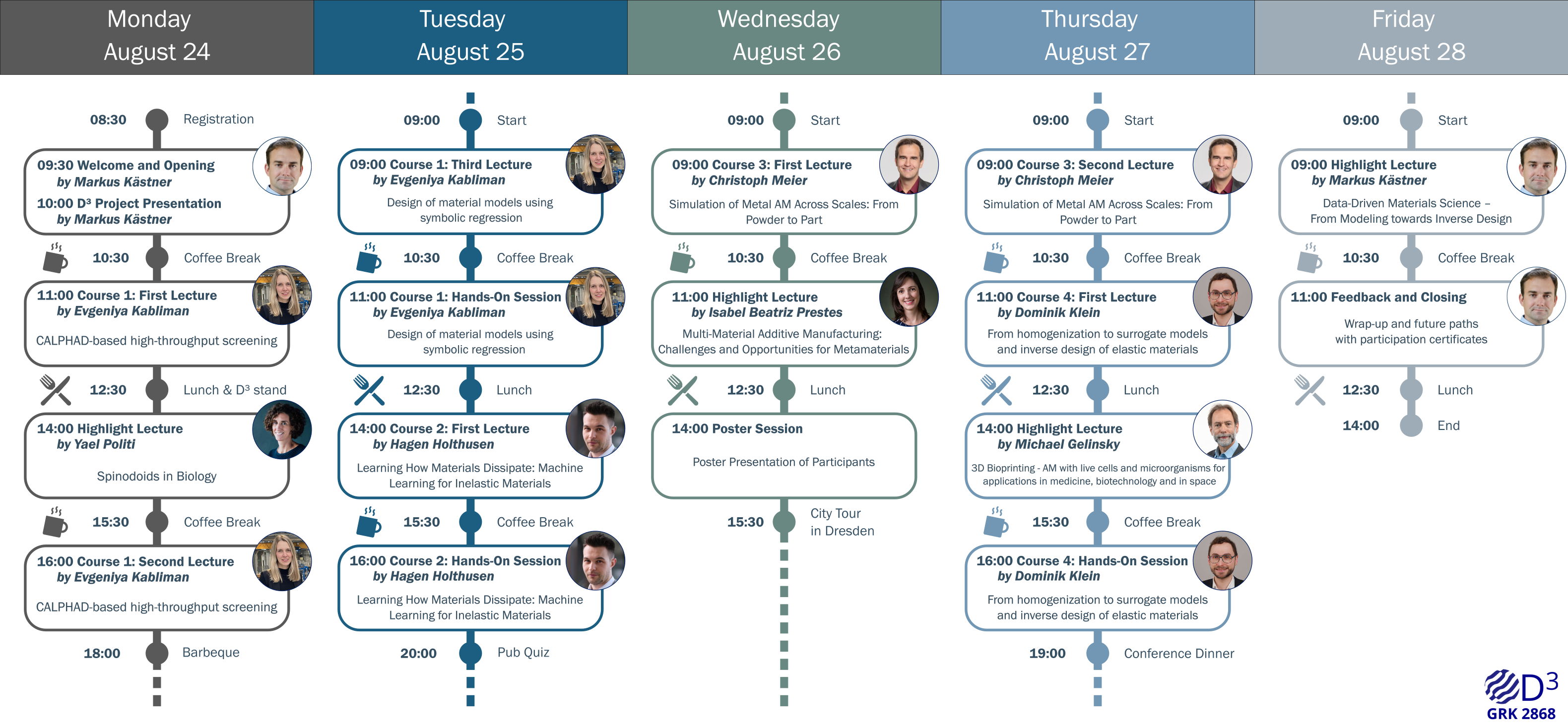
Programme


TBA


The final program will be uploaded soon.

Application


Applications will open on this website on May 11, 2026.


The participants will be selected from the applications as soon as the application period ends and be informed about the decision shortly afterwards.
 

Important for applicants who need a visa to travel to Germany:
  • Please check as soon as possible the visa regulations to visit Germany.
  • Contact the office responsible for issuing visas to enter Germany (embassy, consulate, agency) near your place of residence as soon as possible and find out about waiting times and the duration of visa preparation.
  • Invitation letters will be sent out during the second half of June.

Venue

The summer school will take place
at the Görges Bau on the TU Dresden main campus.

Suggestions for accommodation:

Scientific Board/Organizers

Organizing Board

Acknowledgements


This Summer School is co-funded by the Federal Ministry of Education and Research (BMBF) and the Free State of Saxony as part of the Excellence Strategy of the federal and state governments. The DRESDEN-concept Science and Innovation Campus measure supports, among other things, summer schools in order to strengthen the cooperation of the implementing institutions, to bundle their research expertise, especially in interdisciplinary topics, and thus to further increase the attractiveness of the location for (inter)national students and postdocs.